
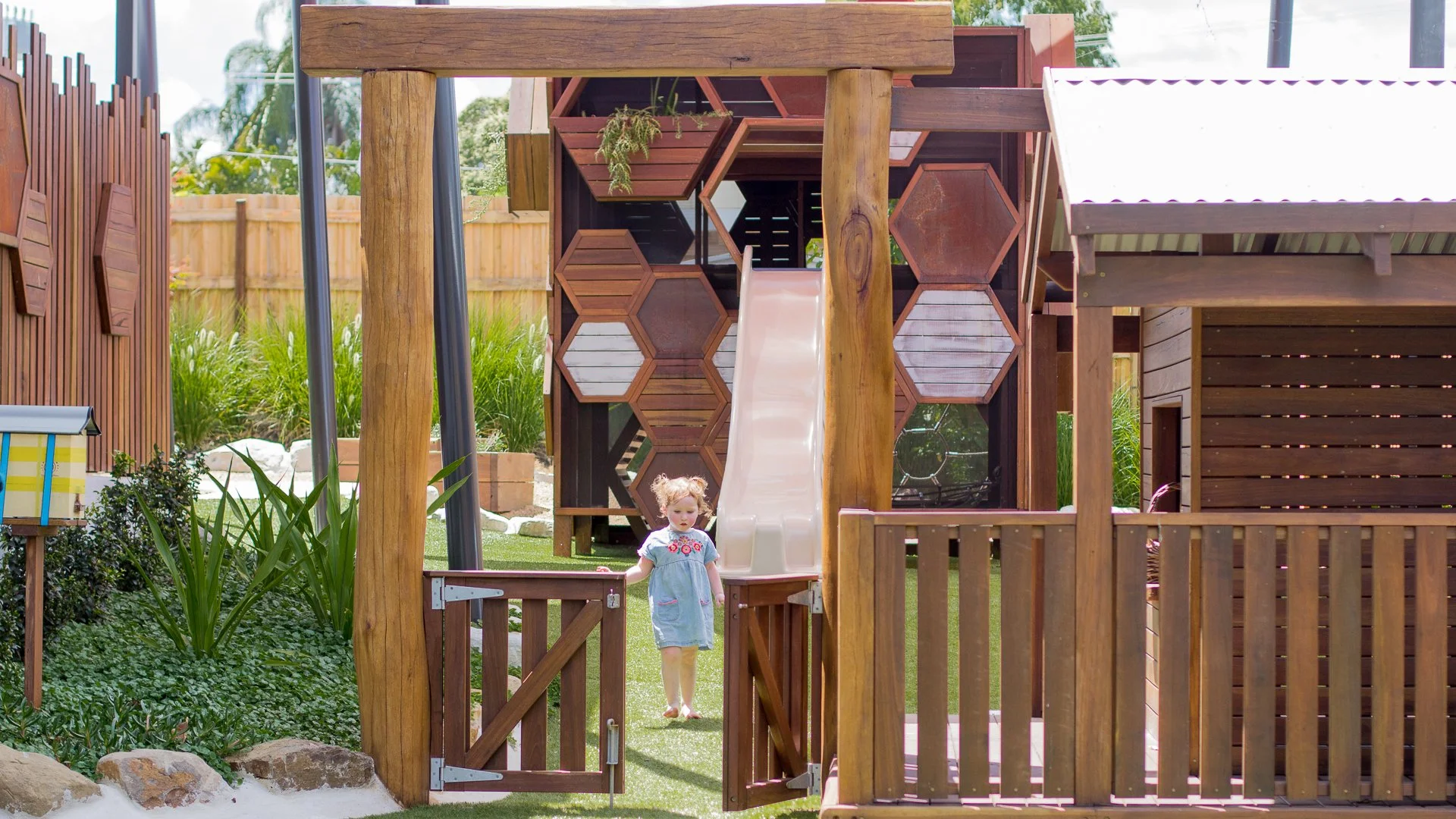
Just as a tree's growth reflects the quality of soil beneath it, children's behaviour is shaped by the environments they inhabit. When Friedrich Froebel created his original 'kindergarten', literally meaning children's garden, he envisioned spaces where children could grow naturally through play and connection to the living world. This metaphor remains profoundly relevant today.
In designing outdoor play environments, I've witnessed this relationship repeatedly. A child once labelled as disruptive finds calm beneath a shady tree. A group prone to conflict begins collaborating when offered loose parts and open-ended space. These transformations aren't accidental; they're invitations created through intentional environmental design.
Emotion Lives in the Landscape
Before a child throws a toy or dissolves into tears, something has already occurred internally. Often, something environmental has contributed too. Emotions don't emerge in isolation; they're shaped by sensory input, perceived safety, and the child's ability to make sense of their surroundings.
Outdoor spaces offer what indoor settings often struggle to provide: a dynamic range of emotional cues and responses. A quiet nook beneath a tree allows retreat and regrouping. Open grassy areas invite large body movement to release tension. Varied textures underfoot help ground sensory-seeking children in the present moment. These landscape features function as emotional regulators.
The rhythms of the natural world play a subtle yet powerful role in emotional development. Light filtered through leaves, the predictable rustle of wind, the earthy smell after rain, all communicate safety to a child's nervous system. From this foundation of safety comes the possibility for connection, exploration, and behavioural flexibility.
Jack, a three-year-old who frequently became overwhelmed during group activities, consistently sought out the garden bed during free play. We expanded this area, adding aromatic plants and creating a gentle pathway with different textures. Within weeks, Jack was using this space to self-regulate before group times, and his challenging behaviours decreased significantly.
When we design with emotion in mind, we create environments that anticipate children's emotional needs before they escalate. The landscape becomes a co-regulator, gently holding children as they navigate developmental complexities.
Behaviour as Communication
In early childhood, behaviour is language. Long before children can articulate their feelings, they show us through action. A child who runs instead of walks, avoids certain areas, or lashes out isn't misbehaving, they're communicating something important about their experience of the space.
Too often, we respond to surface behaviour without asking deeper questions. What is this child trying to tell us about their environment? Is the play area too loud, too crowded, or too predictable? Challenging behaviours frequently reflect unmet environmental needs rather than character flaws.
When we shift from behaviour management to behaviour interpretation, new possibilities emerge. I worked with an educator frustrated by repeated conflicts near their sandpit. Instead of implementing more rules, we examined the space itself. The area was cramped, with unclear boundaries and insufficient tools for the number of children using it. We expanded the space, defined different zones within it, and added varied materials. The conflicts decreased substantially.
"By reading behaviour through an environmental lens, we can respond with solutions embedded in the space itself. We become translators of children's movement, mood, and moments of misalignment."
Lukas Ritson
Designing Ecosystems, Not Zones
Many outdoor environments are divided into zones with singular focuses: sand play here, climbing there, nature exploration over there. While well-intentioned, these spaces often lack supporting elements that would genuinely nurture their intended use. A sandpit without seating, shade, or complementary materials struggles to sustain rich inquiry.
More significantly, many play environments feature individual elements placed across wide open expanses. This approach, while appearing to maximise space, often creates environments where transitioning between activities dominates engagement. Children bounce from element to element at high speed, their play becoming more about movement through space than deep exploration.
Children don't experience the world in isolated categories; they move fluidly, following curiosity, emotion, and developmental needs. They require ecosystems that support sustained engagement, not scattered play stations that encourage restless wandering.
The Ecology of Play framework draws from ecological thinking. In thriving ecosystems, diversity strengthens resilience. Environments that include quiet and active spaces, natural and built elements, loose parts, and sensory-rich materials give children flexibility to meet their own behavioural and emotional needs in real time.
Thoughtful transitions, visual cues, and gentle layout guidance help children feel oriented and safe. A winding path, a cluster of boulders, or a shift in texture can communicate, "You're entering something new. What will you do here?"
Diversity in Play Supports Diverse Expression
Children enter our spaces with varied identities, preferences, sensory profiles, cultural backgrounds, and emotional landscapes. When we offer limited play invitations, we inadvertently narrow the field of acceptable behaviour.
Environmental diversity opens the range of ways children can express themselves authentically. Consider a child who feels hesitant in large groups. If the only option is loud, high-energy play, they may withdraw or act out. Add a quiet sensory garden, natural materials, or a cosy reading nook, and suddenly there's space for engagement on their own terms.
Joshua came from a family where outdoor play meant helping in the vegetable garden. Traditional playground equipment didn't engage him, and educators worried about his participation. When we introduced a digging patch with real tools and plants to tend, Joshua became one of the most engaged children outdoors. His behaviour shifted dramatically when the environment finally reflected his cultural experience and interests.
This is inclusive design at its heart: creating belonging, not just access. When children see themselves reflected in the possibilities of play, their behaviour becomes a natural extension of identity rather than a reaction to discomfort.
Practitioners as Caretakers and Co-Creators
Just as gardens need attentive caretakers, outdoor environments need intentional practitioners to support children's growth. Educators serve as both caretakers of the physical space and co-creators of experiences within it.
Practical strategies begin with simple observation practices. Map behavioural patterns over a week, noting where positive interactions cluster and where conflicts repeatedly arise. Which areas naturally draw children for quiet play, and which amplify energy levels?
Consider inviting children to modify the environment using natural materials or loose parts. A collection of logs, fabric pieces, or shells can become tools for co-design. Children often solve spatial problems that adults overlook, suggesting modifications that significantly improve functionality.
Use observations as genuine data rather than anecdotal reflections. What patterns emerge over time? Does a particular corner consistently generate conflicts when shadows shift? Do certain weather conditions change how children use specific areas? This information becomes invaluable for understanding your environment's rhythms and needs.
Change is seasonal, both literally and metaphorically. What works in one term may need refreshing in the next. Children are excellent co-designers when given opportunity, intuitively understanding what spaces need.
Enriching the Ground
Behaviour emerges from the ground beneath it. When we shift focus from managing children to nurturing the environments they inhabit, we see behaviour as a reflection of place, relationship, and opportunity rather than a problem to solve.
Outdoor spaces hold extraordinary potential as co-regulators, communicators, and catalysts for emotional development. When thoughtfully designed, they become ecosystems of possibility that extend far beyond places to play.
As educators, our role involves listening closely to what behaviour tells us about the spaces we offer. We must observe with intention, design with empathy, and remember that every path, plant, and patch of ground carries potential to support a child's developmental journey.
When we enrich the ground, we don't just grow better environments. We nurture more connected, capable children who can thrive in the rich complexity of their world.
References
- Bilton, H. (2010). Outdoor learning in the early years: Management and innovation (3rd ed.). Routledge. https://doi.org/10.4324/9780203840235
- Bratman, G. N., Hamilton, J. P., & Daily, G. C. (2015). Nature experience reduces rumination and subgenual prefrontal cortex activation. Proceedings of the National Academy of Sciences, 112(28), 8567–8572. https://doi.org/10.1073/pnas.1510459112
- Chawla, L. (2015). Benefits of nature contact for children. Journal of Planning Literature, 30(4), 433–452. https://doi.org/10.1177/0885412215595441
- Curtis, D., & Carter, M. (2014). Designs for living and learning: Transforming early childhood environments (2nd ed.). Redleaf Press.
- Greenspan, S. I., & Wieder, S. (1998). The child with special needs: Encouraging intellectual and emotional growth. Da Capo Press.
- Louv, R. (2005). Last child in the woods: Saving our children from nature-deficit disorder. Algonquin Books.
- Moore, R. C. (2014). Nature play & learning places: Creating and managing places where children engage with nature. Natural Learning Initiative. https://natureplayandlearning.org/
- Perry, B. D. (2006). Applying principles of neurodevelopment to clinical work with maltreated and traumatized children. In N. Boyd Webb (Ed.), Working with traumatized youth in child welfare (pp. 27–52). Guilford Press.
- Rinaldi, C. (2006). In dialogue with Reggio Emilia: Listening, researching and learning. Routledge.
- Sobel, D. (2008). Childhood and nature: Design principles for educators. Stenhouse Publishers.
- Vecchiotti, S. (2001). Constructivist education and the Reggio Emilia approach. ERIC Digest. https://files.eric.ed.gov/fulltext/ED459593.pdf
- White, R., & Stoecklin, V. L. (1998). Children's outdoor play & learning environments: Returning to nature. White Hutchinson Leisure & Learning Group.