
She has been at the digging patch for nearly twenty minutes. Her boots are caked in wet earth, her sleeves pushed to the elbow, her brow furrowed in concentration. She is four years old. She is not being instructed, rewarded, or assessed. She is filling a bucket with dark soil, carrying it to the far end of the garden bed, tipping it deliberately, then returning to start again. Her face is calm. Her body is entirely present. Something in her has found what it needed.
If you have spent time with young children outdoors, you have seen this. A child absorbed in something physical, repetitive, and real. There is no noise around it. No performance. Just a body doing purposeful work and a nervous system quietly settling into itself.
What are we witnessing in that moment? And are we designing outdoor environments that make it possible?
Every practitioner is a designer, whether they think so or not. We all design through our practice, our intention, and the support we offer children as they move through space. The environment reflects the values of the people who tend it. What we place, what we remove, and what we allow are all acts of design. The environment is always being shaped by someone. The question is whether it is being shaped with intention.
What We Have Lost
A generation ago, physical effort was woven into the daily fabric of childhood. Children carried, dug, walked, swept, and moved through the world in ways that demanded something from their bodies. That daily physical workload built strength, regulation, and competence without anyone calling it curriculum.
That workload has been engineered away. Australian children now average thirty minutes of outdoor play during school hours. Physical activity levels have dropped by fifty per cent over the past three decades. The bodies children live in today are receiving far less of what those bodies were designed to need.
The consequences are visible in early childhood settings every day. Fine motor delays. Reduced core strength. Difficulty sustaining focus. Heightened anxiety. Lower frustration tolerance. These are not child problems. They are environment problems. Sedentary environments produce dysregulated children, not because children are broken, but because the spaces they inhabit are failing to meet the needs of the bodies inside them.
A Body That Moves Is a Brain That Learns
Neuroscientist Kelly Lambert offers a powerful framework for understanding why this matters. Her research into what she calls the effort-driven reward circuit reveals that the human brain is designed to reward effortful, purposeful interaction with the world. When the body does something physical and feels the result, a hole dug, a tower built, a path shaped, a neural reward circuit fires. That circuit links effort, identity, and emotional regulation in a single system.
Passive stimulation does not activate this circuit in the same way. Screen-based reward is fast and frictionless. It delivers sensation without resistance, pleasure without mastery. Lambert's insight is that humans feel better after doing, making, and moving. Physical evidence of effort becomes psychological evidence of competence.
Children do not need to be told they are capable. They feel it when they carry something heavy across a yard, when they dig through resistance, when they build something that holds. The outdoor environment, when designed with intention, is the place where that feeling becomes available to every child.
Nothing Grows in Isolation
A tree grows in two directions at the same time. Its roots push downward through dark, damp, resistant earth. Nobody applauds the roots. Nobody photographs them. The work they do is invisible. Gravitropic. Effortful. And entirely necessary.
The canopy is what we see. The phototropic flowering. The growth that reaches toward light, that draws admiration, that shows up in documentation and family updates. Regulation, confidence, resilience, executive function, social capability. These are the outcomes educators and families celebrate.
"The canopy is only possible because of the roots. The work done in the dark makes the growth in the light possible."
Lukas Ritson
The root system and the canopy look remarkably similar in structure. The unseen mirrors the seen. Children grow the same way. The root work is the physical, effortful, sensory-rich play that nobody applauds. Digging, carrying, frustration, repetition, the mess, the struggle, the rebuilding. The canopy is what emerges from it. Resilience is built in the resistance, not despite it. The root pushes through dirt. That is the growth.
Diversity of Opportunity as Inclusion
If the root system is where development begins, the question for educators and designers becomes practical: does our environment support both root work and canopy growth? Does it offer heavy work and retreat? Risk and repair? Effort and rest?
Physicality is broader than big body movement. Following Lambert's framing, physicality is effortful engagement with the world through the body. It includes fine motor construction, carrying and transporting, digging and earthwork, sensory manipulation, tool use, and social physicality. Each of these activates the effort-driven reward circuit differently. Each offers a distinct entry point for a distinct child.
This is what inclusion looks like in an outdoor environment. A child threading rope through timber has a different regulatory need to a child hauling a bucket of wet sand across a yard. A child kneading clay quietly at a table is doing as much neurological work as a child navigating a climbing frame. When we design environments with diversity of opportunity, we make room for every child's root system to grow. We meet them where their bodies are, not where we expect them to be.
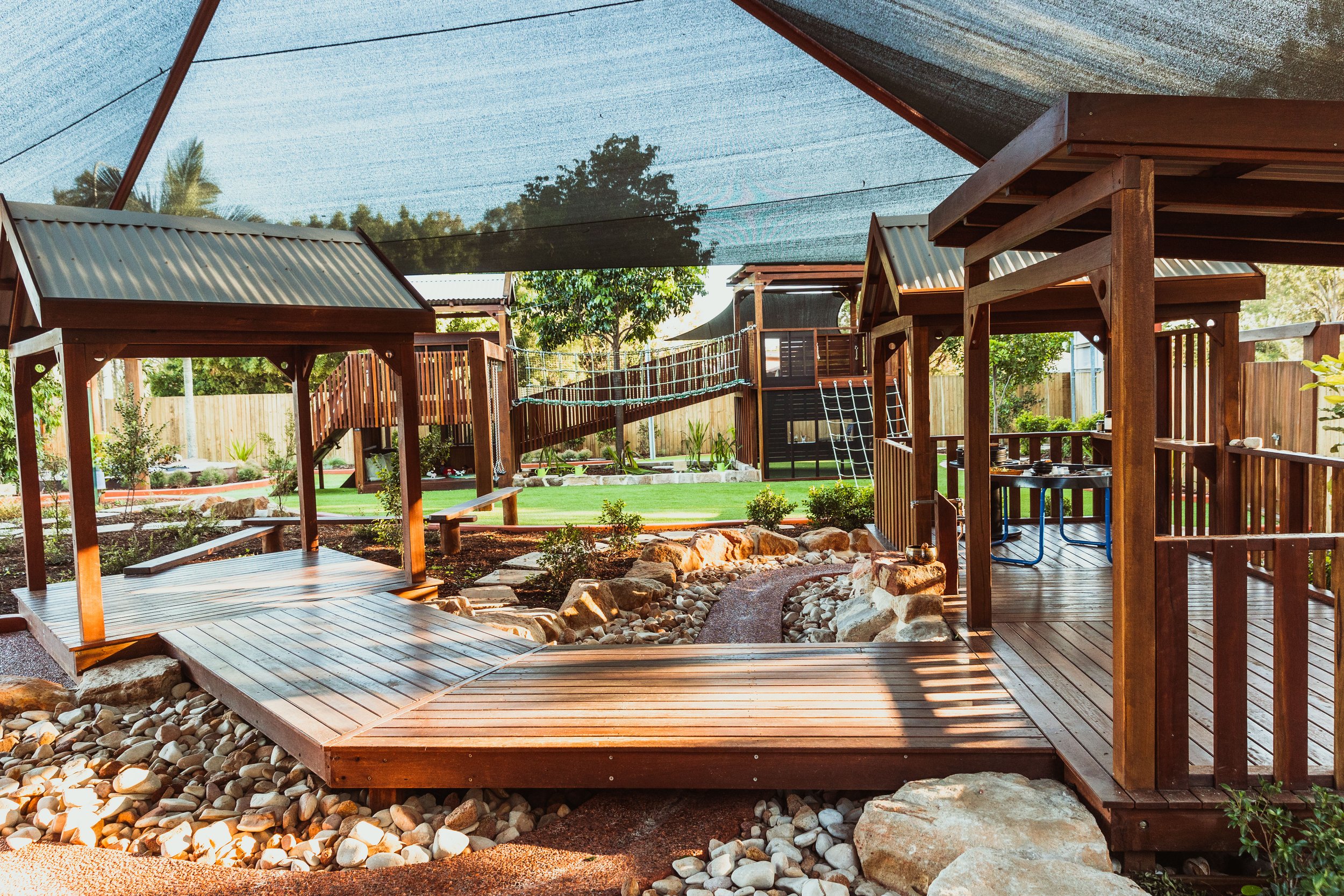
At Winston Glades Early Education Centre, a Wearthy-designed environment produced a thirty-nine per cent increase in step counts across all children within two weeks of installation, with one child recording a one hundred and fifteen per cent individual increase. The environment did not instruct children to move more. It simply made movement irresistible, purposeful, and rewarding.
The Educator as Observer
The tree metaphor asks something of us as educators. Are we watching the roots, not just the canopy? Are we noticing the child who is digging, carrying, struggling, and repeating? Or are we waiting for the visible flowering before we record what is happening?
The most powerful practice emerges when educators observe children closely and adapt environments in response. Observation-based design is not about copying ideas or following trends. It is about watching children and responding to what their bodies seek. This practice is cyclical: observe, test, reflect, adjust. Over time, the environment becomes a physical expression of pedagogy. It reflects intentionality and honours difference.
Three questions are worth returning to regularly. Are we watching the roots, not just the canopy, noticing the child in the effort rather than only the outcome? Does our environment support both gravitropic and phototropic growth, heavy work and rest, risk and repair, mess and mastery? And are we designing for diversity of opportunity, so that every child can find the entry point their body needs?
When environments do this work well, educators experience less emotional load. Supervision becomes less reactive. Children regulate more independently. The outdoor space becomes a genuine third teacher: not a backdrop for play, but an active participant in development. This is the principle at the centre of our Ecology of Play framework, and it is the reason risk and challenge belong in every outdoor environment rather than being designed out of it.
The Work Done in the Dark
Back at the digging patch, the girl is still there. The bucket is full again. She lifts it with both hands, leans slightly into the weight, and begins the walk across the garden. She does not look for approval. She does not need it. Something in her body already knows.
This is what intentional outdoor environments make possible. Not performance. Not compliance. Growth. The quiet, effortful, gravitropic kind that nobody applauds in the moment but that shapes everything that comes after.
Children do not need environments that impress adults. They need environments that are generous enough to let them grow the way they were designed to.
References
- Australian Bureau of Statistics (2022). Children's participation in cultural and leisure activities.
- Ayres, A. J. (1972). Sensory integration and learning disorders. Western Psychological Services.
- Bronfenbrenner, U. (1979). The ecology of human development: Experiments by nature and design. Harvard University Press.
- DEEWR (2022). Belonging, being and becoming: The early years learning framework for Australia (V2.0). Australian Government.
- Ginsburg, K. R., et al. (2007). The importance of play in promoting healthy child development and maintaining strong parent-child bonds. Pediatrics, 119(1), 182–191.
- Gray, P. (2011). The decline of play and the rise of psychopathology in children and adolescents. American Journal of Play, 3(4), 443–463.
- Lambert, K. (2008). Lifting depression: A neuroscientist's hands-on approach to activating your brain's healing power. Basic Books.
- Rinaldi, C. (2006). In dialogue with Reggio Emilia: Listening, researching and learning. Routledge.
- Tandon, P. S., et al. (2012). Home environment relationships with children's physical activity, sedentary time, and screen time by socioeconomic status. International Journal of Behavioral Nutrition and Physical Activity, 9(88).